
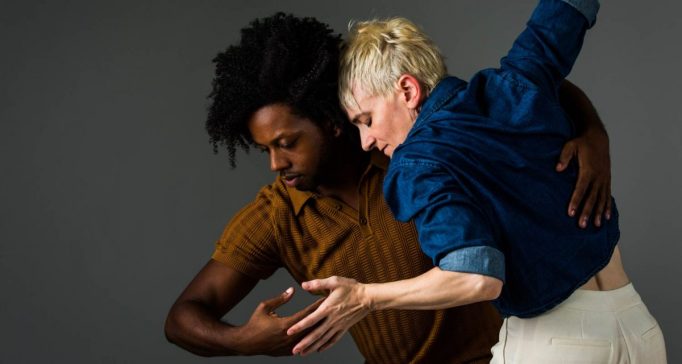
A Scene from “Home.” Gibney Dance Company.
Home
Gibney Dance Company
The Theater
November 16, 2018
Not a Home I Want to Live In
Both “Imprint Ghosts” and “Menagerie” were world premieres. “Menagerie,” the second piece, is described as a “strange or diverse collection of people or things in a household unit.” It was also said to be made for 6 dancers; 5 roses, 4 FREEDAS, 3 hundred unicorns, 2 co-creators and 1 home. I have no idea what a FREEDA is nor, beyond the dancers, did I see any of the other items. What I observed was a self-indulgent work with a group of dancers in black lace tops moved around with devices that vaguely resembled ironing boards and metal poles. I feared for their safety—might the man who thrust his head through the “machine” get stuck? Would there be a potentially dangerous clash of poles? There wasn’t much dancing and what there was seemed that it might have emanated from Shamel Pitts (credited as the choreographer although the concept and co-creation includes Deville Cohen) having told the dancers to feel free to express themselves. There was no joy, no discovery—in fact, no emotion of any kind and not in the way of plotless dance, which can be well-worth seeing for interesting patterns and moves.
At the rear of the set was a large tub-like container that made me immediately recall Chekov’s thought about foreshadowing: i.e., if you say in the first chapter that there is a rifle hanging on the wall, in the second or third chapter it absolutely must go off. If it’s not going to be fired, it shouldn’t be hanging there, I waited for someone to sit in it. Sure enough, Amy Miller did and then tipped it over spilling out a large number of what looked like small, multicolored plastic packages (maybe these are the FREEDAS?)
The music by Sivan Jacobovitz was akin to being in the dentist’s chair although my companion thought she heard sounds of a washing machine. The program notes say the work was “loosely inspired by Tennessee Williams’ The Glass Menagerie. My understanding of that play is that it deals with the inability and unwillingness to accept reality. I couldn’t find any relationship between the play and this jumbled, awkward “exploration.” If this is a home, I’m glad it’s not mine.
Happily, the opening work, Adam Barruch’s “Imprint Ghosts,” was more rewarding. Featuring Nigel Campbell, Zui Gomez, Amy Miller and Jesse Obremenski, combining movements both smooth and angular, exploring hands, and reaching, not quite touching heads, perhaps a reference to the ghosts that remain in physical space after they have been there? The piece is a little too long or maybe it was made to seem so by the music by Roarke Menzies that felt like the aural equivalent of throbbing pain.
I appreciate that Gibney Dance facilitates movement workshops for survivors of intimate partner violence and develops programming that addresses pressing issues in the dance field. I also applaud the effort to showcase work by new choreographers. Maybe a little more dance and a little less focus on social movement might have led to a more enjoyable performance?
Formed in 1991 by Gina Gibney, Gibney boasts over 25 years of international performance through Gibney Dance Company; social justice and humanitarian work on a global scale through Gibney Community Action; and forward-thinking service to the performing arts community.

