2014

An Arts Press Event

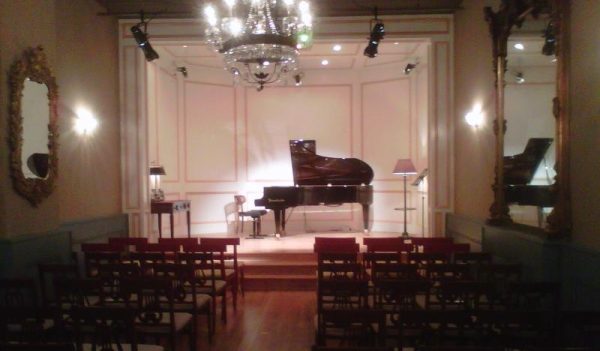
Stephen Porter played late works by Beethoven, Schubert, Chopin and Debussy at the House of the Redeemer in Manhattan, Thursday May 1, at 7.30 pm—a presentation of New York Arts

We were extremely proud to present, as our single concert of this season, a piano recital by Stephen Porter, a musician of supreme intelligence, sensitivity, and learning. His pianism is equally developed on the fortepiano as on the modern fortepiano, and we are fortunate that his curious ear for historical instruments has drawn him to the unique qualities of the House of the Redeemer's Grotrian-Steinweg grand in the intimate acoustics of its Library.

Literature

Seneca Rides Again! James Romm, Dying Every Day – Seneca at the Court of Nero

I was seduced into reviewing this book by a very upbeat and encouraging event at the New York Public Library on 42nd Street—an institution from which little encouraging has emerged in recent years. (Opponents of the obscene plan to gut the stacks and set up an Internet café in their place should remain on the watch!) Following an afternoon of research, during which I learned that in mid-nineteenth century Providence, Rhode Island purveyors of "healthy, hungry leeches" and tamed performing grizzly bears had more visibility in the marketplace than calligraphers, I felt drawn to a conversation between James Shapiro, the Columbia Shakespearean, who has written numerous well-received books on and around WS, and James Romm of Bard College, the author of a new book about Lucius Annaeus Seneca the Younger, Dying Every Day - Seneca at the Court of Nero. Both have been fellows of the New York Public Library's Cullman Center, Shapiro wrote his splendid Contested Will: Who Wrote Shakespeare?, surely the best treatment of the topic ever, while a Fellow, and Romm now follows him with his contribution to the "Seneca Problem."
New York Arts in London

King Lear at the National Theatre, London

One of the odd and unique interesting qualities of King Lear is its fantastic and vague setting in prehistoric Britain, that Shakespeare chose a tale of a king you couldn’t find in a list of the Kings and Queens of England, even while he gave the play something of a history play shape, with British Kings and princes, crises of succession and fighting with each other and France. But it isn’t a history play, it's based on a britannic myth that was already a myth in the middle ages, and the play is set around about some time in the misty, undocumented bog before Ethelwulf, Egbert and Offa, and after Arthur, but perhaps not, maybe it predates the Romans, maybe even the Celts? It's in a parallel timeline no doubt.
Music

Young, Gifted, and Playing Strads…or, It Doesn’t Get Any Better than This!

If you’re convinced you’ve visited every major live-performance venue for the best in classical music in New York City, well, music-lovers, have I got good news. I’m happy to announce another cardinal direction to add to your compass rose (besides Lincoln Center, Carnegie Hall, and the 92nd Street Y), start heading South. Yes, South! Serious chamber lovers, violin aficionados, and Maverick Festival-ers can now put Workshop for Music Performance (W.M.P.) Concert Hall on your radar for exquisite classical music. It’s a hidden gem on a short not-so-hidden block on East 28th (between Madison and Park) across from the CBS News building. If you’re in the neighborhood at 12:30 on a Monday, drop in to a wonderful concert series called “Strad for Lunch.”
Theater

Throes Theater Company presents the Spalding Grey-inspired Halfway through the Story of Our Life

The amazingly talented Alexandra Zelman-Doring’s latest creation is a comic investigation of identity that brings three actresses, three musicians and three composers together for an engaging hour of music and verse. From Ms Doring — “The search that ensues when “we wake to find we have been living in a dream we chose to call “reality.” Why are we as we are? Who is the “persona” that builds up in and around us?”
Berkshire Review

Handling Handel: Mark Morris’ Acis and Galatea, plus more Handel, Monteverdi, BLO’s I Puritani, the Met’s Cenerentola, and other adventures in opera-land

The Mark Morris Dance Group was back in Boston with the East Coast premiere of a major new work, Handel’s ravishing pastoral opera Acis and Galatea, under the aegis of the Celebrity Series of Boston, one of the co-commissioners. I loved it. Or to put it more accurately, I’m in love with it, and saw three of its four performances at the Shubert Theatre. Morris has now staged several complete operas and one Handel oratorio. At least two of these are generally regarded as his masterpieces: Purcell’s one-act opera, Dido and Aeneas (1989), in which all the singers are offstage and the dancers play the main characters; and Handel’s L’Allegro,il Penseroso ed il Moderato (1988), in which the singers are also offstage, and there are no characters. But in Rameau’s delectable Platée (1997) and in Morris’s productions of Gluck’s Orfeo ed Euridice (Handel and Haydn Society, 1996; the Metropolitan Opera, 2007), singers played the leading roles and appeared on stage along with the dancers.
WP2Social Auto Publish Powered By : XYZScripts.com